

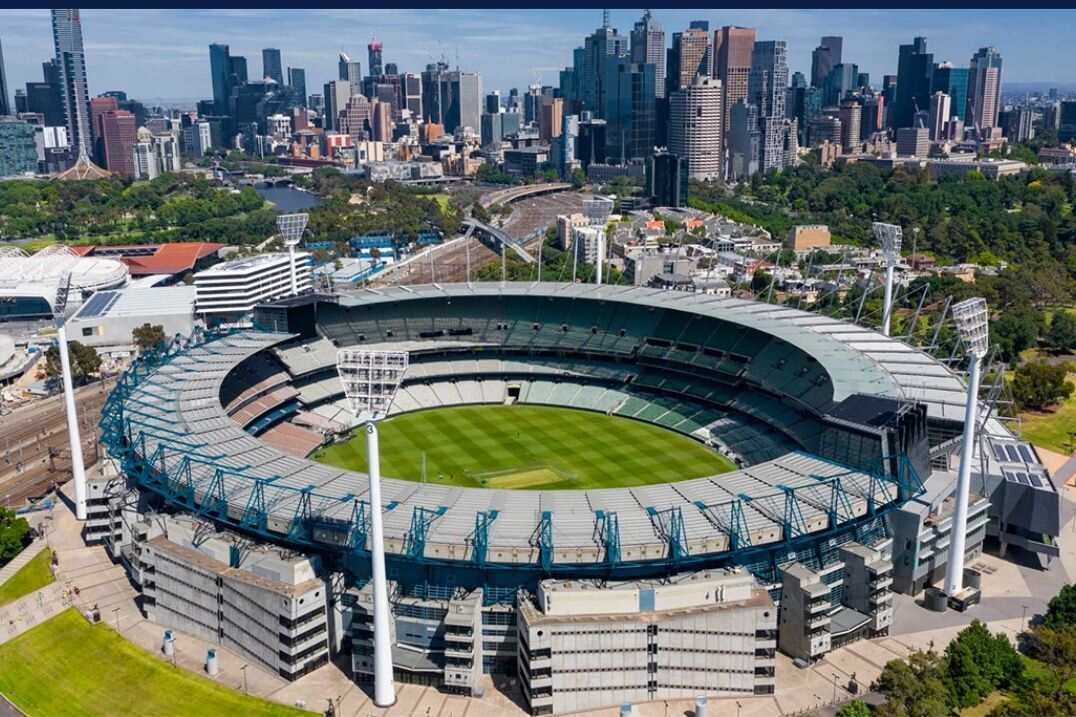
The Melbourne Cricket Ground (MCG) is a popular cricket stadium worldwide. The stadium, located in Melbourne, Victoria, Australia, was founded in 1853 and has been used for international cricket for over 100 years. It is famous for its huge size, historic games, and the Boxing Day Test. It has seen Test matches, ODIs, T20Is, and big international tournament matches.
The MCG is renowned for having big boundaries, top-notch sporting facilities, and rabid ‘boffalo’ supporters. It can provide opportunities for batters and bowlers in general, but it depends on the format, the weather, and the state of the surface.
This article contains Melbourne Cricket Ground pitch reports, average scores, boundary length, pitch records, chasing statistics, and famous international performances at Melbourne Cricket Ground.
Melbourne Cricket Ground: Overview
The Melbourne Cricket Ground (MCG), also referred to as the MCG, is a large sports stadium in Yarra Park, Melbourne, Victoria, Australia. It was built in 1853 and is one of the oldest cricket grounds in the world and is home to Cricket Australia and the Melbourne Cricket Club (MCC). Owning the stadium is the Melbourne Cricket Club and it hosts international sporting events, such as cricket matches as well as Australian rules football and other major events.
It is especially renowned for the Boxing Day Test match that starts on 26 December. The MCG can hold around 100,024 people. It played host to the 1956 Summer Olympics and the 2006 Commonwealth Games. It has also been the site of some of the biggest international cricket events, like the 1992 ICC Cricket World Cup and the 2015 ICC Cricket World Cup. The ground has a large playing area, historic buildings, modern facilities, and a sporting atmosphere. It also houses the Australian Sports Museum, which showcases the country’s sporting history and achievements.
| Stadium Information | Details |
| Stadium Name | Melbourne Cricket Ground |
| Popular Name | MCG |
| Location | East Melbourne, Victoria, Australia |
| Established | 1853 |
| Managed By | Melbourne Cricket Club |
| Capacity | Approximately 100,000 |
| Country | Australia |
| International Team | Australia |
| Domestic Team | Victoria |
| Big Bash Team | Melbourne Stars |
| Floodlights | Yes |
| First Men’s Test | Australia vs England, 1877 |
| First Men’s ODI | Australia vs England, 5 January 1971 |
| First Men’s T20I | Australia vs South Africa, 2008 |
| Main Formats | Test, ODI and T20I |
| Famous Match | 2015 Cricket World Cup Final |
| Major Annual Event | Boxing Day Test |
| Playing Surface | Natural grass with a drop-in pitch |
| Cricket Association | Cricket Australia |
| City | Melbourne |
| State | Victoria |
| Stadium Type | International multi-sport stadium |
History of Melbourne Cricket Ground
In 1853, the Melbourne Cricket Ground was opened and became a notable place for Australian cricket. This was made more significant because it was the site of the first-ever Test match between Australia and England in March 1877. Australia won the match by 45 runs, with Charles Bannerman having scored 165 runs. In January 1971, Australia defeated England for the first time in an ODI at the MCG.
The stadium later became a regular host for international cricket tournaments and bilateral series. The 2015 Cricket World Cup final was played on the ground where Australia beat New Zealand. It also played host to the final of the 2022 Men’s T20 World Cup in which England defeated Pakistan by five wickets.
| Historical Event | Details |
| Established | 1853 |
| First Men’s Test | Australia vs England, 1877 |
| First Men’s ODI | Australia vs England, 1971 |
| First Men’s T20I | Australia vs South Africa, 2008 |
| 1992 Cricket World Cup | Hosted matches |
| 2015 Cricket World Cup | Hosted the final |
| 2022 Men’s T20 World Cup | Hosted the final |
| Annual Cricket Event | Boxing Day Test |
| Historic Batter | Charles Bannerman |
| Major Role | International cricket and major sporting events |
Melbourne Cricket Ground Pitch Report
The Melbourne Cricket Ground (MCG) is generally a level cricket field, which is suitable for batters and bowlers. The bounce and pace of the pitch can benefit the fast bowlers by providing them with opportunities to create movement and trouble batsmen, especially at the start of a game. Batters can also run when they get used to the circumstances and get comfortable at the crease. The surface can vary in behavior based on the preparation of the pitch, the weather, and the type of match. The pitch can be helpful to seamers early in the game but may also be helpful to the spinners later on in the match in Test cricket. Spinners also have an opportunity to contribute (the amount of turn depends on the match).
Since 1996, the MCG has been utilising portable drop-in pitches. It also has a large playing area, which can also make it difficult to hit the boundary in some directions. In general, the ground can give a good battle between bat and ball, but playing conditions are dependent on the match in question.
Melbourne Ground Weather Conditions
Melbourne’s weather can change quickly, with sunshine, cloud cover, wind, and rain affecting playing conditions. Cloud cover may assist swing bowling, while dry weather can make batting more comfortable.
| Weather Factor | Possible Effect |
| Cloud Cover | May assist swing bowling |
| Cool Conditions | Can help fast bowlers |
| Sunshine | May offer comfortable batting conditions |
| Wind | Can influence swing and fielding |
| Rain | May interrupt play |
| Dew | Can make gripping the ball difficult |
| Dry Weather | Can influence surface wear |
Also, Explore: Dr. DY Patil Sports Academy Pitch Report, Stats, Records, Capacity, Recent Matches & Future Outlook
Melbourne Cricket Ground Dimensions
| Measurement | Dimensions |
| Cricket playing area (approx.) | 172.9 m × 147.8 m |
| AFL ground dimensions | 160 m × 141 m |
| Straight cricket boundaries (guideline) | 75 m |
| Square cricket boundaries (guideline) | 85 m |
| Cricket pitch length | 22 yards (20.12 m) |
| Stadium capacity | 100,024 |
Melbourne Ground Transport Availability
The Melbourne Cricket Ground (MCG) is easily accessible from all areas of Melbourne, with a variety of public transport options available. There are train, tram, bus, taxi, and private car transport available. Jolimont Station is the nearest train station from which to walk to the stadium. There is another convenient option, Richmond Station.
Main Transport Options –
Train: Jolimont Station is about 350 metres from the stadium and Richmond Station is around 850 metres from the stadium. Due to the multiple routes, the MCG is easily accessible by tram: Routes 48, 70 and 75.
Bus: Route 246 runs between Clifton Hill and Elsternwick, making a stop near Punt Road.
Taxi and Rideshare: You can rent a taxi or rideshare service (dropoff/pickup points available).
Car: (Limited Parking) Parking is available in Yarra Park for certain events. Public transport is encouraged for visitors.
Records at Melbourne Cricket Ground
T20I Records
| T20I Record | Details |
| Highest Total Listed | 186/5 – India |
| Opponent | Zimbabwe |
| Tournament | 2022 Men’s T20 World Cup |
| Lowest Total Listed | 74 – Australia |
| Opponent | India |
| Average First-Innings Score | Approximately 140–150 |
| Average Second-Innings Score | Approximately 120–135 |
| IPL Records | Not applicable |
| Main Pitch Characteristic | Large boundaries and good bounce |
Highest Score
The MCG has hosted several high-scoring international matches. Australia have produced major totals in Test and ODI cricket, while India have recorded a notable T20I total at the venue.
| Format | Highest Score | Team | Opponent |
| Test | 624/8 declared | Australia | Pakistan |
| ODI | 355/5 | Australia | England |
| T20I | 186/5 | India | Zimbabwe |
| IPL | Not applicable | — | — |
Lowest Score
The MCG has also witnessed several low-scoring innings. Fast bowling, movement, and difficult batting conditions have contributed to historic collapses.
| Format | Lowest Score Listed | Team | Opponent |
| Test | 36 | South Africa | Australia |
| ODI | 94 | England | Australia |
| T20I | 74 | Australia | India |
| IPL | Not applicable | — | — |
Chasing Records
Successful chases at the MCG demonstrate that teams can win after batting second. However, the difficulty depends on the format, pitch conditions, and quality of the opposition.
| Chasing Record | Score | Team | Opponent |
| Highest Test Chase Listed | 332/7 | England | Australia |
| Highest ODI Chase Listed | 308/5 | England | Australia |
| Highest T20I Chase Listed | 172/5 | Sri Lanka | Australia |
| IPL Chase Record | Not applicable | — | — |
Good Score
A competitive score at the MCG depends on the format and match conditions. ODI totals around 250–280 can provide a useful starting point, while T20I totals around 150–170 may be competitive on certain surfaces.
| Format | Potentially Competitive Score | Strong Total |
| Test | 300–350 in the first innings | 400+ |
| ODI | 250–280 | 300+ |
| T20I | 150–170 | 180+ |
| IPL | Not applicable | Not applicable |
Recent Records
The MCG remains a major venue for Australia’s international cricket calendar. The Boxing Day Test is one of its most prominent annual fixtures, while the ground also hosts selected ODI and T20I matches.
| Recent Record | Details |
| 2022 Men’s T20 World Cup Final | England vs Pakistan |
| Winner | England |
| Result | England won by 5 wickets |
| Highest Listed ODI Total | 355/5 – Australia |
| ODI Opponent | England |
| ODI Record Date | 22 November 2022 |
| Highest Listed T20I Total | 186/5 – India |
| T20I Opponent | Zimbabwe |
| Major Annual Fixture | Boxing Day Test |
ODI Records
The Melbourne Cricket Ground hosted the first men’s ODI in January 1971, when Australia defeated England by five wickets. Since then, the venue has hosted numerous international matches and major tournaments.
| ODI Record | Details |
| First Men’s ODI | Australia vs England, 5 January 1971 |
| Highest Total | 355/5 – Australia |
| Opponent for Highest Total | England |
| Highest Successful Chase Listed | 308/5 – England |
| Opponent in Highest Chase | Australia |
| Highest Individual Score Listed | 180 – Jason Roy |
| Year of Individual Record | 2018 |
| Best Bowling Figures Listed | 6/42 – Ajit Agarkar and Yuzvendra Chahal |
| Main Characteristics | Large boundaries and good bounce |
Test Records
Test cricket is central to the history of the MCG. The ground hosted the first men’s Test match in 1877 and remains famous for the Boxing Day Test.
| Test Record | Details |
| First Men’s Test | Australia vs England, March 1877 |
| Highest Team Total Listed | 624/8 declared |
| Team | Australia |
| Opponent | Pakistan |
| Lowest Team Total Listed | 36 |
| Team | South Africa |
| Opponent | Australia |
| Famous Annual Fixture | Boxing Day Test |
Recent T20I Records
The MCG has hosted important T20 Internationals, including matches during the 2022 Men’s T20 World Cup. India scored 186/5 against Zimbabwe, while Australia were dismissed for 74 against India.
| T20I Record | Details |
| Notable Match | India vs Zimbabwe |
| Tournament | 2022 Men’s T20 World Cup |
| India’s Score | 186/5 |
| Notable Low Total | Australia 74 |
| Opponent in Low-Scoring Match | India |
| Pitch Characteristic | Large boundaries and potential pace assistance |
Conclusion
The Melbourne Cricket Ground is one of the world’s most storied cricket grounds. It was founded in 1853 and has played host to the inaugural men’s Test match, the first ODI, and many big Cricket World Cup games, as well as the iconic Boxing Day Test. The MCG pitch normally provides a fair game for the batters and bowlers. It can aid fast bowlers with bounce, and the bigger boundaries can affect batting strategies in limited-overs cricket. The results are subject to change depending on format, weather and pitch preparation. The MCG is one of the most significant venues in international cricket, with a history of great sporting events.
FAQs
The stadium was established in 1853.
The pitch is mostly good for all types – good bounce for the batters, and there are chances for the fast bowlers.
The highest ODI team score for the venue is 355/5 for Australia against England in November 2022.
The distance of the boundary varies depending on the pitch and direction. Actual match-day field layouts determine exact measurements.
Also, Read –
Dharamshala Stadium: Pitch Report, Records, Average Score, Boundary Length & Stats (2026)

, also referred to as the MCG, is a large sports stadium in Yarra Park, Melbourne, Victoria, Australia.)